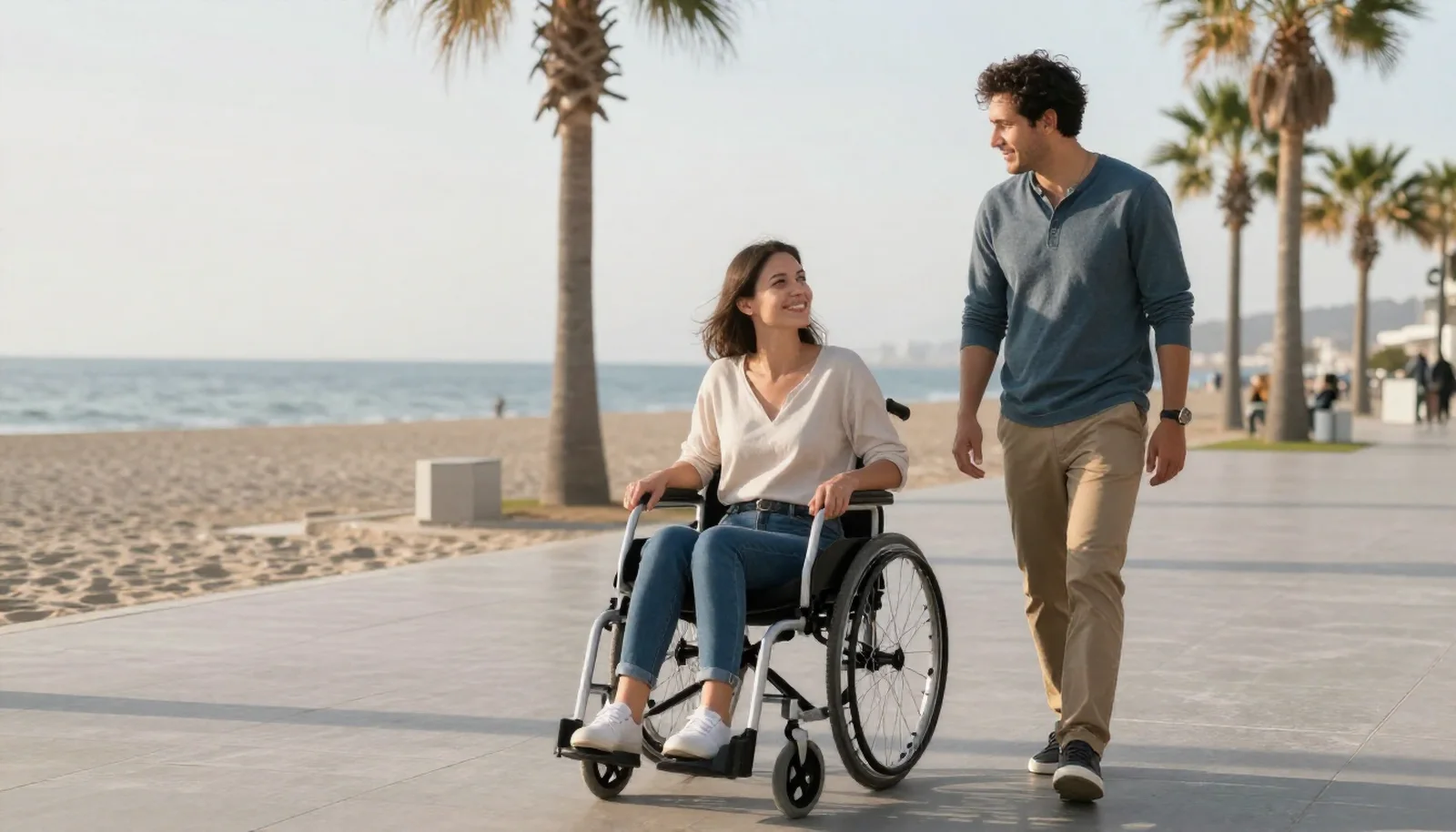
To plan an accessible trip with reduced mobility, start by researching how easy the destination is to get around, then ask your accommodation for concrete details such as door widths, shower type and lift size instead of relying on the word "accessible". Request airport and airline assistance well before you fly, ask your airline how your wheelchair or mobility device and its batteries will be carried, and check that your travel insurance covers your health needs and your equipment. Rules and services differ between airlines, countries and providers, so always confirm the details with the airline, the provider or an official source.
Every disabled traveller knows their own body, needs and equipment best. This guide does not tell you what you can or cannot do; it offers a practical checklist so that planning takes less energy and the trip itself brings fewer surprises. It is general guidance, not legal or medical advice.
How do you research an accessible destination?
Two cities that look similar on a map can be very different to move around in. Before you book, look at the things that will shape your days:
- Pavements and streets. Are there dropped kerbs, smooth surfaces and wide pavements, or mostly cobblestones, steps and narrow paths? Street-level photos in map apps can give a first impression.
- Hills and slopes. A compact old town on a steep hill may be harder to get around than a larger, flatter city. Check the terrain around your accommodation and the places you want to see.
- Public transport. Find out whether buses are low-floor, whether metro and train stations have working lifts, and whether there is an accessible taxi service. Many transport operators publish accessibility information and step-free maps on their websites.
- Climate and season. Heat, cold, rain or snow can affect energy levels, health conditions and how equipment works. A quieter season can also mean fewer crowds at stations and sights.
Accessibility information online can be out of date, so where it matters, contact the tourist office, transport operator or venue directly. Reviews and forums written by other disabled travellers can also help, as long as you remember that everyone's needs are different.
What does "accessible" mean at a hotel or rental?
The word "accessible" does not mean the same thing everywhere. For one place it means a step-free entrance; for another it means a fully adapted room with a roll-in shower. Instead of only asking whether a room is accessible, ask specific questions and request photos:
- Entrance and routes. Are there steps at the entrance, to the lift or to the breakfast room? Is there a ramp, and how steep is it?
- Door widths. Ask for the width of the room door and the bathroom door, and compare them with the width of your wheelchair or walker.
- Bathroom. Is there a roll-in shower or a bath? Are there grab rails, a shower seat and space beside the toilet for a transfer?
- Lift. Is there a lift, how large is it inside, and does it reach every floor you need?
- Bed and room space. How high is the bed, is there space under it for a hoist, and is there enough turning space beside it?
Ask for the answers in writing and for photos of the room you will actually get, not just a sample room. Confirm the booking again a few days before you arrive, because a specific room is not always guaranteed unless it has been confirmed.
How do you arrange airport and airline assistance?
Many airports and airlines offer assistance for passengers with reduced mobility, for example help through check-in and security, a wheelchair to the gate, or help getting on and off the aircraft. What is offered, how far in advance you need to ask and how you request it differ between airlines and airports, so check with your airline before you book and again before you fly.
It usually helps to request assistance when you book or as soon as possible afterwards, to describe clearly what you need (for example, whether you can walk short distances or manage steps), and to keep a written confirmation. On the day, arrive early and tell the check-in staff that assistance has been booked. If you have a connecting flight, ask how assistance works at the transfer airport as well.
Flying with a wheelchair or mobility device
If you use a wheelchair, scooter or other mobility device, talk to your airline early about how it will travel. Points to ask about and prepare:
- How it is carried. Ask whether you can use your own wheelchair up to the aircraft door and whether it will be returned to you at the door or at baggage claim.
- Battery rules. Powered devices have rules about battery type and size, and some batteries need to be removed or protected. These rules vary, so ask your airline what applies to your device and have its details ready.
- Protecting your device. Remove loose parts such as cushions and footrests where possible, and attach simple instructions for folding or moving it.
- Recording its condition. Take photos before handing it over, and report any damage before you leave the airport.
It is also worth finding out whether equipment can be rented or repaired at your destination, in case something goes wrong.
Medication, documents and travel insurance
Pack your medication in your hand luggage with enough to cover delays, keep it in its original packaging and carry a copy of your prescriptions. Some medicines are restricted in certain countries, so check the rules of your destination with its embassy or another official source before you travel. A short letter from your doctor about your condition and equipment, translated if needed, can help at security checks and if you need care abroad.
When you choose travel insurance, read the policy carefully. Check that it covers any existing health conditions if you need that, and whether your wheelchair or other equipment is covered for loss, damage or repair, and up to what value. If anything is unclear, ask the insurer and get the answer in writing.
Getting around locally and choosing accessible tours
Plan the first journey from the airport or station before you arrive, as it is often the most tiring part of a trip. Ask whether accessible taxis or transfers can be booked in advance. In the city, check step-free routes, which stations have lifts and whether those lifts are often out of service.
For sightseeing, some tour companies offer accessible tours with adapted vehicles or guides who know step-free routes. Ask them the same concrete questions you asked your accommodation: about vehicles, ramps, toilets and walking distances. Museums and attractions often have accessibility pages with information on routes, lifts, seating and any terms for companions, so check these before you go.
Travelling with a companion and leaving room for rest
Some people travel with a partner, friend or personal assistant; others prefer to travel independently and arrange help only where needed. Whatever suits you, agree beforehand who does what, especially for things like transfers or carrying luggage. If you would like company for part of a trip, on mytripdate you can see who is travelling to the same city on the same dates and send them a message. Get to know people through messages first, look for a verified profile, meet in a public place, and remember that a new acquaintance is not a replacement for a trained assistant.
Finally, build flexibility into your plans. Leave buffer time between activities, plan rest days and have a backup for days when your energy or the weather does not cooperate. A slower plan that you enjoy is worth more than a full schedule that wears you out.
Frequently asked questions
How early should I request airport assistance?
As early as possible, ideally when you book. Each airline sets its own deadline, so check yours and keep the confirmation.
Can I take my powered wheelchair on a plane?
Often yes, but battery and packing rules vary. Ask your airline before you book and give them the details of your device and its battery.
Is an "accessible room" always suitable for a wheelchair user?
Not always. Ask for door widths, bathroom details and photos of the actual room, and compare them with your own needs.
Does travel insurance cover my wheelchair?
It depends on the policy. Check whether mobility equipment is covered and up to what value, and get the insurer's answer in writing.